Last Updated on by Azib Yaqoob
Online reputation management (ORM) prices are hard to compare, because providers sell different things under the same name. One quote covers a few profile pages, another covers months of content and link work, and a third is really a lawyer’s letter.
This guide explains what you are actually paying for, which cost factors move the price, and how to judge a quote. It does not give a market price list, because I cannot verify a reliable public one. It does cover where my own past pricing sat, and when doing it yourself is the better call. For the full picture of the work, start with how to remove negative search results from Google.
Quick answer
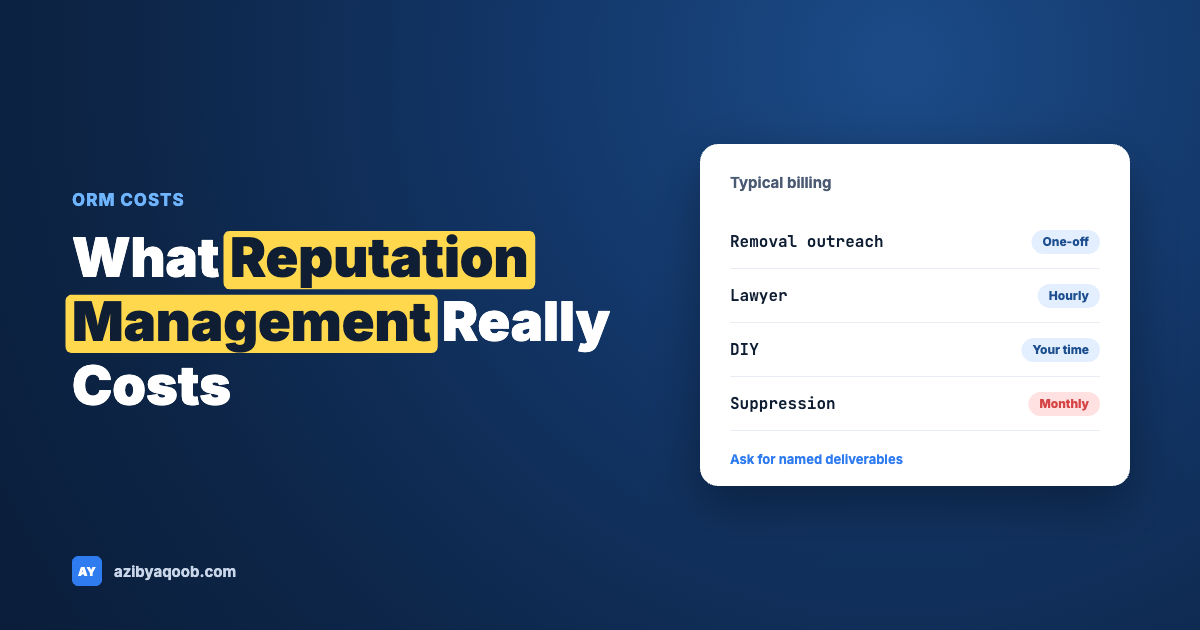
- Removal (getting a page taken down) is often priced as a one-off. Suppression (pushing results down) is usually monthly, because it is ongoing work.
- Lawyers are typically hourly or per matter, and are the right route for defamation, sealing records and court orders.
- From 2017 to 2023 I charged $500 to $2,500 per month for ORM, mostly manual work. That is one person’s past rate, not a benchmark for today.
- Nobody can honestly promise a Google ranking. Ask what you get each month, in named deliverables.
Table of Contents
What you are paying for
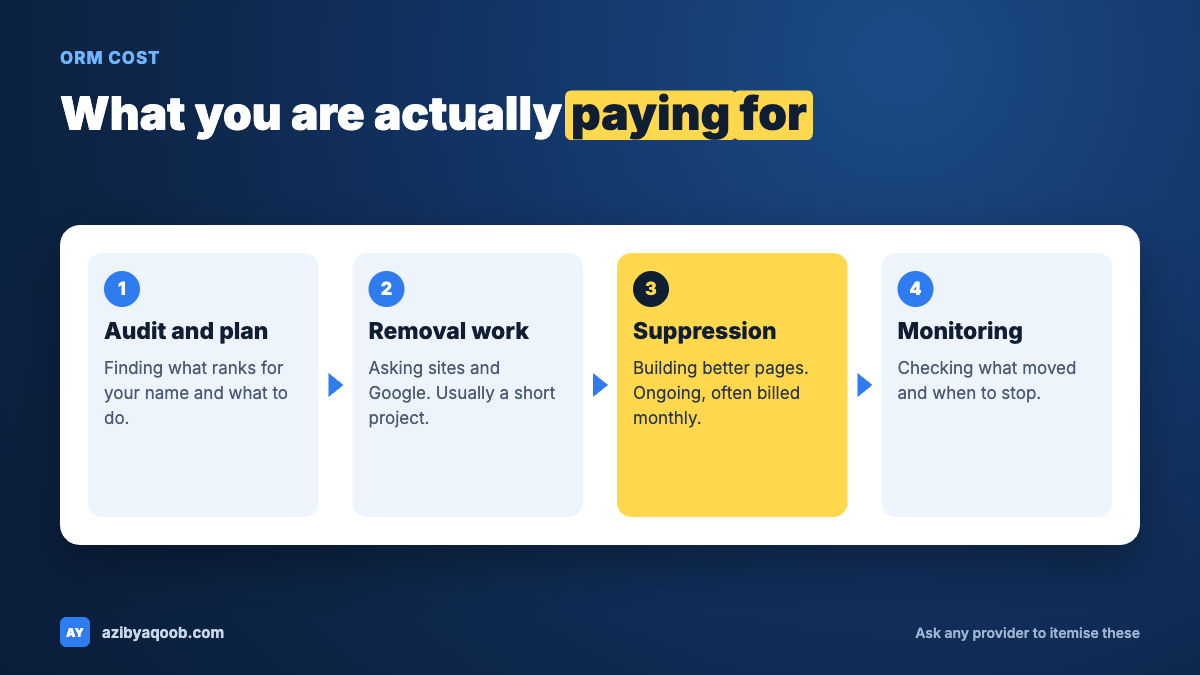
ORM is not one service. Break any quote into the work behind it:
- Audit and plan. Finding what ranks for your name, what is negative, who owns each page and what can be removed.
- Removal outreach. Contacting site owners and publishers, filing Google requests where a policy fits, working with a lawyer when needed.
- Building owned assets. Websites and profiles that can rank for your name.
- Content creation. Articles, bios, interviews, guest posts and press that earn rankings.
- Link work and promotion. Getting the new pages found and trusted.
- Monitoring and reporting. Tracking rankings and new mentions over time.
When I did ORM, the monthly cost was mostly manual labour: creating and updating profiles, building links and writing articles. That is still the nature of suppression work, even though AI now speeds up drafting.
The three routes and how they are usually billed
| Route | How it is usually billed | Best for |
|---|---|---|
| DIY | Your time, plus a domain and hosting if you build a site | Uncommon names, mild negative results, tight budgets |
| Agency or consultant | Often monthly, because suppression is ongoing | Strong negative pages, several results, no time to do it yourself |
| Lawyer | Hourly or per matter | Defamation, sealing or expungement, takedown demands, court orders |
The routes are not exclusive. A common mix: a lawyer for the legal parts and a consultant or DIY effort for suppression. See the suppression section of the main guide for what the work involves.
What changes the price
Ask any provider how each of these applies to your case, because they explain most of the difference between quotes.
- How many negative results there are. One result is a smaller job than eight.
- How strong those pages are. A page on a major news site is harder to move than a thin blog post.
- How common your name is. A common name means crowded results and name mix-ups, which can make positive pages harder to rank. A rare name can be easier.
- Removal or suppression. Removal can be one-off. Suppression runs for months.
- Your starting point. If you already own a strong site and profiles, there is less to build.
- Competition and geography. Local searches differ from national ones.
- Legal complexity. Cross-border cases, court orders and sealing add legal fees.
- Deliverables per month. A quote for a handful of profile updates is not the same as a quote for articles, outreach and reporting.
The speed you want matters too. Be wary of anyone who says they can finish quickly for a cheap price. Real movement takes months. For a general view of timing, see how long SEO takes to work.
How long you pay for
Removal is usually a short project. Suppression has no fixed length, but it does have a sensible end point. In one case, I worked with a US client for about seven months on local news articles about a petty crime. By the end, all of the negative articles had been pushed to page 3. After we watched them for two months, I suggested the client stop, because more monthly spending was not needed. I monitored for a year afterwards and the articles never resurfaced.
Not every case ends that neatly. With one long-term client, I pushed a negative result off page one, and a different one appeared weeks later. That one did not move for months, then a Google algorithm update cleared the negative results. Algorithm shifts surprise clients more than the person doing the work, so a good provider tells you at the start that timing is uncertain.
Ask a provider: when would you suggest we stop, and how will we decide? A provider who cannot answer may be selling an open-ended subscription.
How to judge a quote
Use this checklist before you sign anything.
- Does it list deliverables? Names, numbers and dates: for example “four profile builds in month one”, not “reputation improvement”.
- Does it avoid guarantees? Promises of removal or page-one rankings by a fixed date are a warning sign.
- Does it separate removal from suppression? They are different jobs with different costs.
- Does it explain how removal would work? If a provider says they can delete a news article or Reddit post for a fee, ask exactly how. They cannot force a publisher or a platform to act. Google’s page on exploitative sites that charge for removal shows that some sites post content and then demand payment, so be careful about who is on the other side.
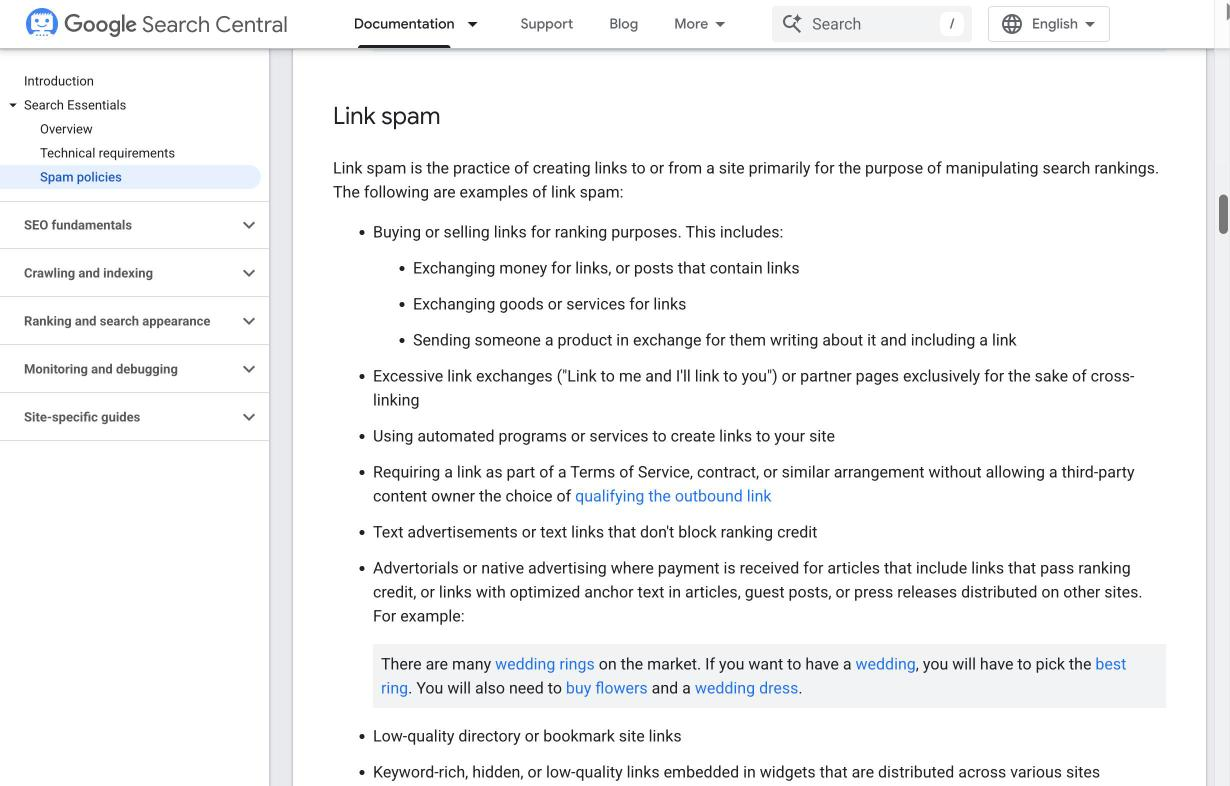
- Does it describe the methods? You want to know whether they use real content and real mentions, or fake reviews, spun articles and link schemes that can backfire.
- Who owns the assets? Domains, profiles and content built for you should be yours when the work ends.
- Is there a contract term? Check the minimum length and the cancellation terms.
- Will they report? Rankings by date for your key searches, plus what was done.
Hiring a person versus a company
Individuals and small consultancies can cost less than agencies, but they may be less able to cover legal work or a large content push. If you are choosing between providers, how to hire a freelance SEO service provider lists questions that apply here too: ask for specifics, ask how they report, and be careful with anyone who will not describe their method.
Doing it yourself, with AI to cut the time
The work is mostly time, so DIY is a real option for rare names and mild problems. AI tools can reduce the hours, as long as you supply the facts.
I want to rank better pages for my name. Here is my list of current search results (URL, type, positive or negative): [paste list]. Suggest which kinds of pages I should create to compete for the first page, and give me a four-week task list. Do not invent facts about me. Where you need a fact, ask me.Paste your audit list under the prompt. Treat the output as a to-do draft, not a strategy guarantee.
Draft a short professional bio for [name]. Use only these facts: [role, years of experience, location, work I can prove]. Write three versions: 60 words, 120 words and 200 words. Keep the same facts in each. Do not add awards, clients or numbers I did not give you.Use the bios across your site and profiles, adjusting a little so you do not publish identical text everywhere. Check any AI output before publishing, because a made-up claim on your own site creates a new problem.
What DIY still needs: a domain and hosting if you build a site, a few hours a week, patience and a tracking sheet. See how to check your website’s keyword ranking accurately for tracking. As of November 2026, many AI tools have free tiers, but limits and features change, so check the current plans.
Confidential help
Want a realistic read on your case?
If you need help working out what your case would take, send me what is ranking and any quotes you have. I will tell you which work is worth paying for and which you can do yourself.
Get confidential helpYour message stays private. No obligation.
When to spend money, and when not to
Spend on a lawyer when the content is false and harmful, when a record may be eligible for sealing, or when you need a legal notice sent. See Google’s Defamation Overview for what it asks for in such requests.
Spend on a consultant or agency when negative pages are strong, when there are several of them, or when you have no time. Ask for named monthly deliverables and a plan for when to stop.
Do not spend on anything promising guaranteed deletions, on packages of fake reviews, or on mass-produced pages. They can make things worse.
Do it yourself first if the issue is small and your name is uncommon. You can always hire help later with a clear audit in hand, which also makes any quote easier to judge. For a wider approach to your name online, see how to repair your online reputation.
FAQ
How much does online reputation management cost?
It depends on the work. Removal is often a one-off fee, suppression is usually monthly, and legal help is hourly or per matter. When I did this work from 2017 to 2023, I charged $500 to $2,500 per month. Treat that as one person’s past rate and ask for quotes.
Is ORM a monthly fee or a one-time cost?
Removal can be one-time. Suppression is usually monthly, because it involves ongoing content and link work. A good provider tells you when to stop.
How long do I need to pay for suppression?
It varies. One case I worked on took about seven months, and we stopped after the results stayed down for two months. Other cases take longer or end differently. There is no fixed length.
Can I do online reputation management myself?
Yes, for uncommon names and mild problems. It takes time rather than money. Audit your results, build owned pages, publish useful content and monitor. AI tools can speed up drafting.
Does online reputation management guarantee results?
No honest provider can guarantee a Google ranking or a removal. Look for clear deliverables instead.
Conclusion
A fair price is one you can explain: you know what is being done each month, why, and when it ends. The main guide to suppressing negative search results lists the steps you are paying for. Start with an audit, split the work into removal, legal and suppression, and ask every provider to name their deliverables.
If you would like a second opinion on a quote, or an honest view of what your case needs, send me the details.
Confidential help
Need a second opinion on a quote?
If you need help judging a reputation management quote or plan, tell me what is showing up. You get a straight answer on what can be removed, what needs suppression and what you can do yourself.
Talk to me confidentiallyYour message stays private. No obligation.