Last Updated on by Azib Yaqoob
An old arrest, a booking photo or a court record can follow you long after the case is over. Employers, landlords and clients search names, and these pages tend to rank because they contain your exact name.
This guide explains what can realistically be removed, what Google will and will not do, and how to push down what stays. It is one case within the wider guide to removing negative search results from Google. It is general information, not legal advice. Laws differ by country and state, so involve a lawyer for anything involving sealing or expungement.
Quick answer
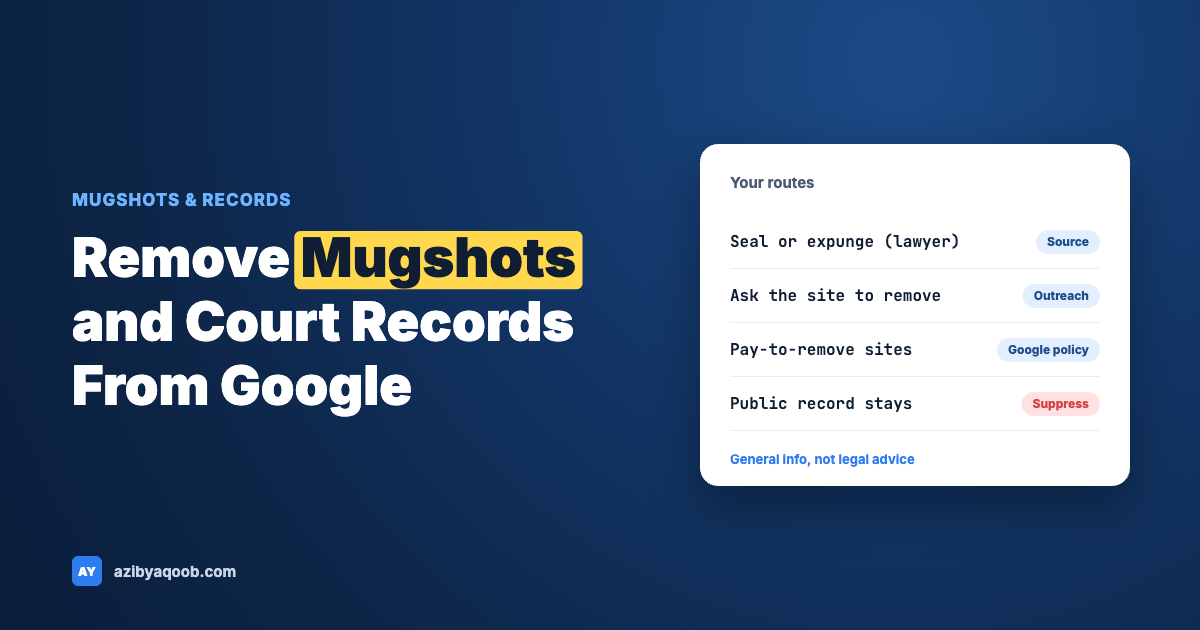
- Best outcome: the record is sealed, expunged or corrected where the law allows, and the site that republished it removes the listing.
- Google’s role: Google can delist a page only in limited cases. One is a site that demands payment to remove content about you. A public record that is accurate usually stays.
- If it stays: push down the results by building better pages for your name. It takes months and is never guaranteed.
- Never pay a site that threatens to keep a listing up until you have checked your options.
Table of Contents
Mugshots, court records and news are three different problems
People lump these together, but each has a different owner and different options.
| Type | Who controls it | Typical route |
|---|---|---|
| Court record on an official site | The court or government | Sealing, expungement or correction through the legal process, usually with a lawyer |
| Mugshot or booking listing on a republishing site | The site owner | Ask the site to remove it, check Google’s exploitative-site policy, then suppress |
| News article about the arrest or case | The publisher | Ask for an update or correction, otherwise suppress |
| Background-check or people-search listing | The data broker | Opt-out request, then Google removal request if needed |
Start by listing which of these show up for your name. A search in a private window, with your name in quotes and with words like arrest, mugshot, court or case, will show most of them.
Step 1: Fix it at the legal source if you can
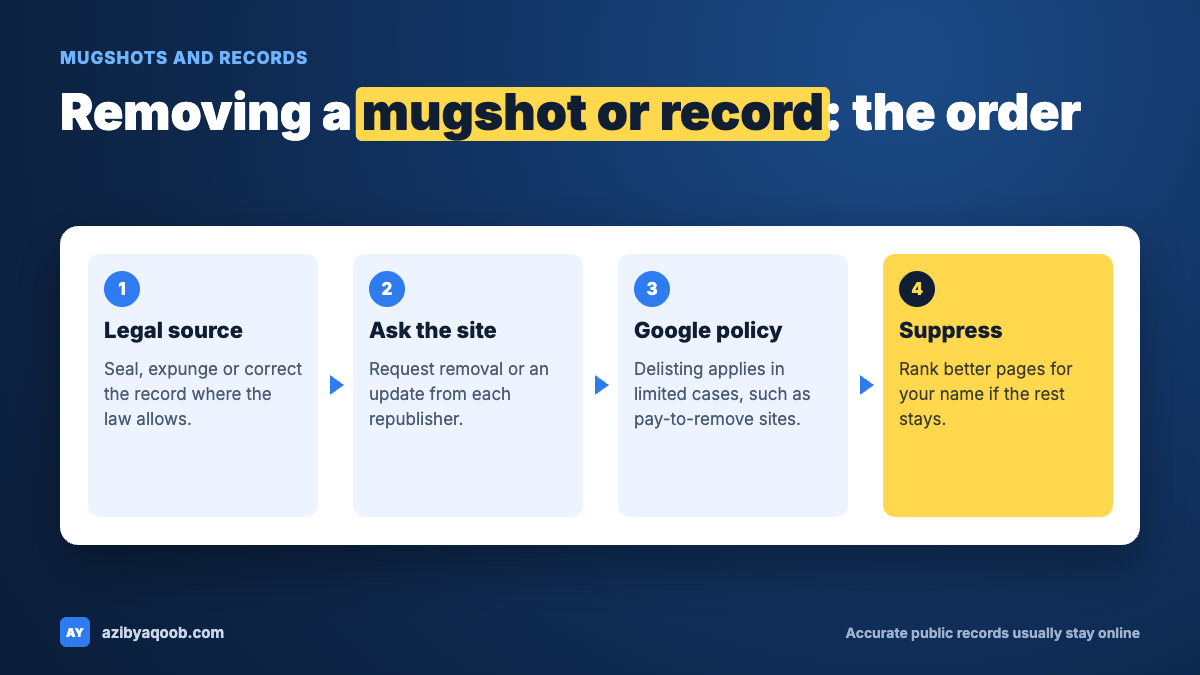
The only way to make the underlying record go away is through the process that created it. What is possible depends entirely on where you live and what the outcome was. In some places a dismissed case, an acquittal, a finished sentence or an older minor offence can be sealed or expunged. In others it cannot. Ask a local lawyer, or a legal aid office, what is available.
If your record is cleared, get the paperwork. A court order or a clear document makes every later request easier. Sites, publishers and Google weigh evidence, not stories.
Do not assume clearing a record removes copies. Mugshot sites, news archives and data brokers may keep their own copies and may not update them. So the legal step comes first, then you send the paperwork to each site.
Step 2: Ask the site to remove or update the listing
For each republishing site, look for a removal or contact page. Send a short, polite request:
- The exact URL of the listing.
- What changed: case dismissed, record sealed, wrong person, wrong details.
- A copy of the court order, if you have one.
- What you want: removal or an updated outcome.
An AI tool can help you write a clear request. Give it facts and keep the tone calm.
Write a short, polite request to a website owner asking them to remove or update a page about me. Facts: the page is at [URL]. It concerns [type of listing]. Since publication, [outcome, for example the case was dismissed on DATE / the record was sealed on DATE]. I am attaching [document]. I want the listing removed. Keep it under 150 words. Do not threaten anyone and do not add claims that are not in my facts.Fill the brackets, read the result, and send it from your own email. Keep copies of everything you send and every reply.
Step 3: Watch out for pay-to-remove sites
Some sites publish arrest or mugshot information and then charge a fee to take it down. Paying can feel like the quick way out, but it has risks: there is no guarantee the page stays down, the fee may repeat, and the same data may sit on other sites.
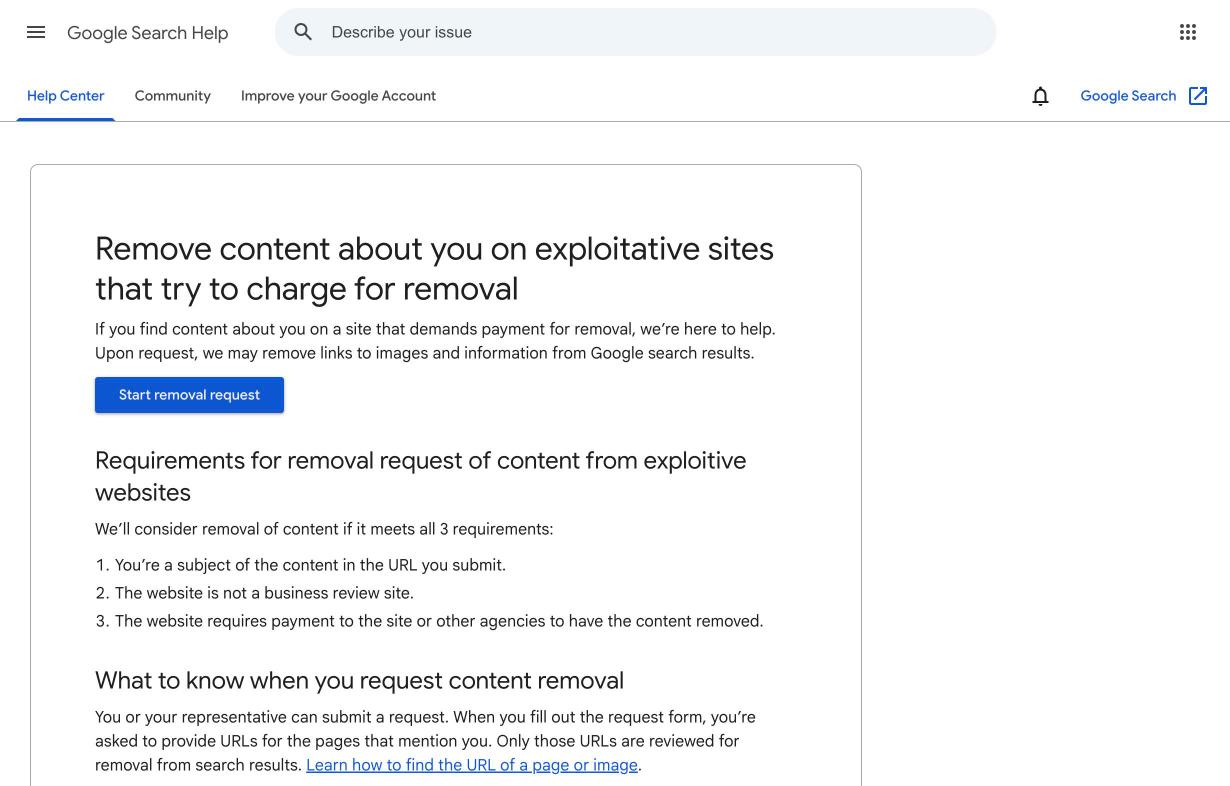
Google has a policy for this. Its help page on exploitative sites that charge for removal says Google may remove links when all three of the following apply: you are the subject of the content, the site is not a business review site, and the site requires payment to remove the content. You submit the URLs of the pages, explain how the site is exploitative, and Google reviews only the URLs you submit. If a request is approved, the URL stops showing in Google, but the content may still exist elsewhere. The page does not say whether mugshots or court records qualify as such, so do not assume a decision before you try.
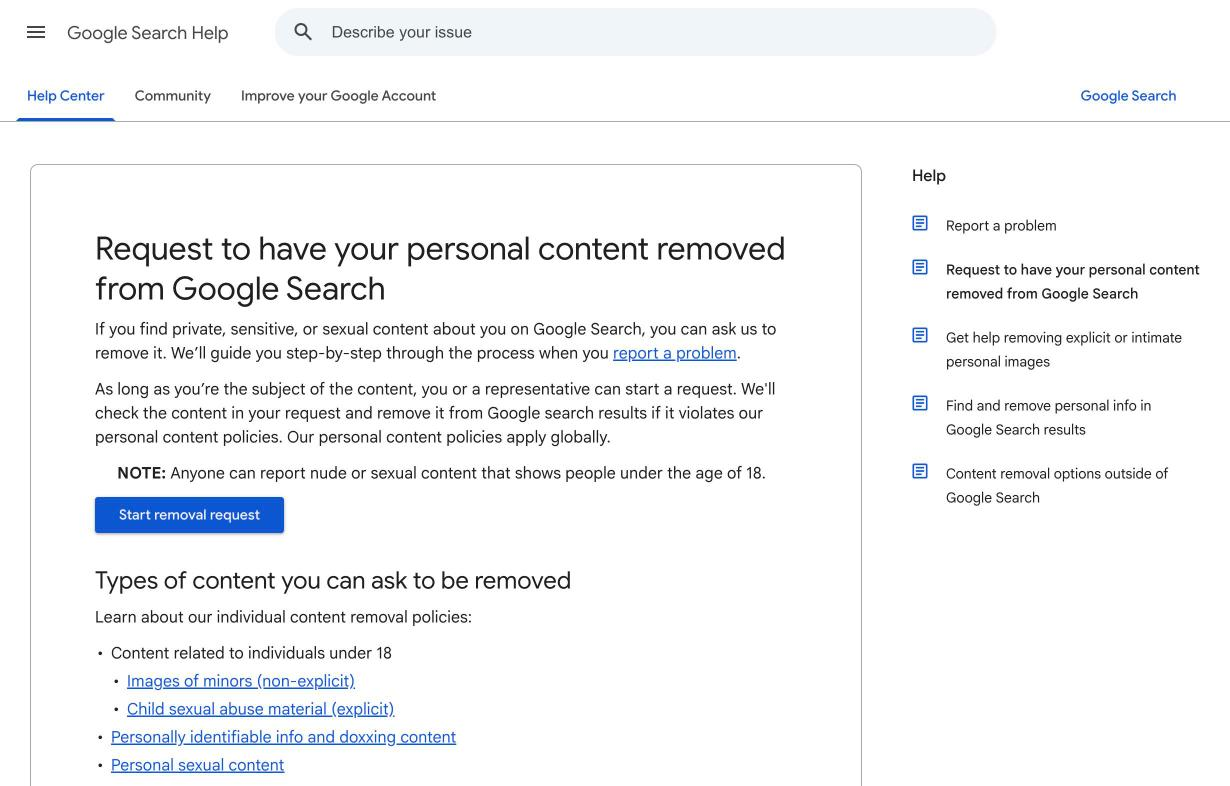
Google’s wider page on personal content removal requests lists the other policy categories it handles, such as private information and explicit images. A booking record that is accurate and public does not usually fall under those, so be realistic about what you file.
Step 4: Use Google’s other routes where they fit
Depending on what the page shows, one of these may apply:
- Private details on the page (government ID numbers, bank details, signatures): Google’s private info removal page.
- Your contact details on a listing: the Results about you tool.
- The page was changed or deleted, but Google still shows the old text: request a refresh of outdated content.
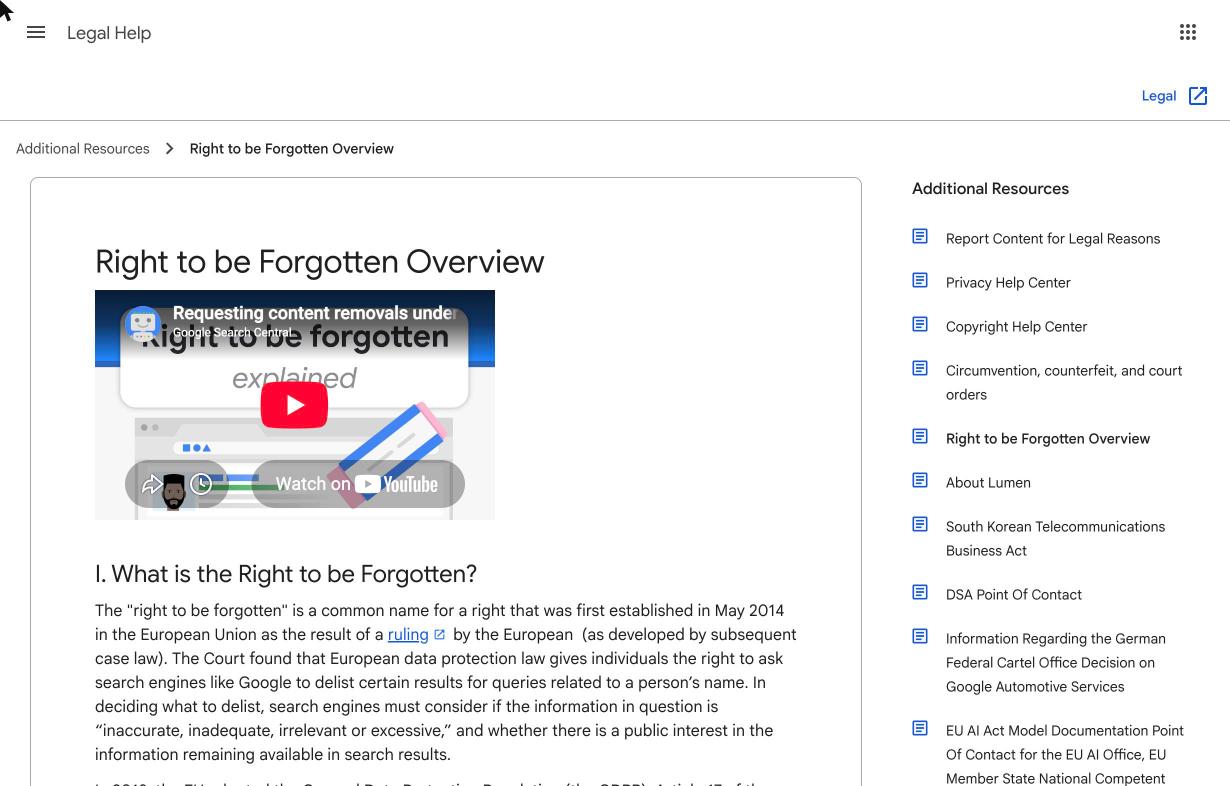
- Right to be forgotten (EU and UK): Google’s overview says requests are judged on whether information is inaccurate, inadequate, irrelevant or excessive, balanced against public interest. Delisting applies to name searches in the relevant territory.
- False statements: Google’s Defamation Overview describes what it needs. Accurate records are not defamation.
Step 5: Suppress what remains
If a record or mugshot page stays, the remaining option is to make sure other pages rank above it for your name. The full method is in the suppression section of the main guide. The short version:
1. Audit the top 20 results for your name and variations. Note which are negative and who controls them.
2. Build owned pages: a simple personal site with an About page, your work and a contact page, plus properly filled profiles on sites that tend to rank for names.
3. Publish useful content: an expert bio, work you can share, interviews, guest posts and local press for things you have actually done.
4. Link everything together and make sure Google can index the pages.
5. Monitor weekly at first, then monthly.
Some mugshot and record sites are thin pages that rank mainly because they contain your exact name, which can make them easier to outrank than a major news site. That is not guaranteed, and progress is still measured in months.
Here is one real example, not about mugshots but close in nature. A US client had local news articles about a petty crime showing for their personal name. We worked together for about seven months, and by the end all of the negative articles had been pushed to page 3. After watching two months, I suggested the client stop paying for the work. I monitored for a year and the articles never came back. The lesson is that suppression has an end point: once results stay down, you watch them and do not keep paying.
Confidential help
Not sure what can be removed and what has to be pushed down?
If you need help with a mugshot or court record in your results, send me what shows up. I will tell you which parts can be removed and which need a different approach.
Get confidential helpYour message stays private. No obligation.
Using AI for this job, and its limits
AI tools are useful for the writing and organising parts of this work:
- Drafting polite removal requests and follow-ups.
- Turning a messy list of URLs into a tracking sheet.
- Outlining a bio or an article about your real work.
- Summarising a long Google help page into a checklist for you.
They are not useful as legal advisers, and they can invent laws, court procedures and deadlines. Never rely on an AI answer about whether your record can be sealed. Ask a lawyer or the court. Also do not paste a full case file with sensitive details into a tool you do not trust. Share only what is needed.
Mistakes to avoid
- Paying the first site that asks without checking Google’s policy and your other options.
- Hiring anyone who promises guaranteed removal. Nobody controls courts, publishers and Google at the same time.
- Threatening site owners. It often hardens their position.
- Sending a request for a record that is accurate and still open. It will be refused, and it can annoy the people you need.
- Posting fake reviews or fake profiles to bury results. It can backfire and become another story.
- Stopping too early. Early weeks show little movement even when the work is going well.
For more on managing how you appear online overall, see how to repair your online reputation. If the result is a news story about the same event, the news article guide covers that route in more detail. Set up a Google Alert on your name with Google’s Create an alert page so you hear about new pages quickly.
FAQ
Can I remove a mugshot from Google?
Sometimes. Google can delist a page in limited cases, such as sites that charge for removal, or where private info or other policy categories apply. If the listing is accurate and public, Google often keeps it. The most reliable route is removal at the source.
Can court records be removed from Google search results?
Not directly in most cases. The record itself changes only through the legal process (sealing, expungement or correction where available). After that, ask the sites and, where it applies, Google to update or remove listings.
Does expunging a record remove it from the internet?
No. It changes the official record, but copies on other sites may remain until each site removes them. Send your paperwork to each site and keep monitoring.
Should I pay a mugshot site to take my photo down?
Check your options first. Look at Google’s policy on exploitative sites and ask a lawyer. Payment does not guarantee permanent removal and the data may be on other sites.
How long does it take to push mugshots and records down in Google?
Often a few months for results on a strong name, longer if the pages are strong. Timelines vary and nothing is guaranteed.
Conclusion
Start with the legal route if it is open to you, because that changes the source. Then deal with each site, use Google’s routes where they truly fit, and push down what remains (the main guide on how to push down negative search results covers that step). Keep records of every request and keep watching your name.
You do not have to carry this alone. If an old record is affecting your work or your housing search, send me the details and I will tell you what is realistic.
Confidential help
Need help with a mugshot or court record?
If you need help with an old arrest or record that keeps showing in Google, tell me what is ranking. You get a straight answer on what can be removed and what needs suppression.
Talk to me confidentiallyYour message stays private. No obligation.