Last Updated on by Azib Yaqoob
A news article about you or your business ranks high when someone searches your name. It may be wrong, outdated, or accurate but old. Each of those has a different best route, and some of them will not work at all.
This guide shows how to decide which case you are in, how to ask a publisher for a correction or update, what Google will and will not do, and how to push the article down when it stays. It is one part of the wider topic of how to remove negative search results from Google.
Quick answer
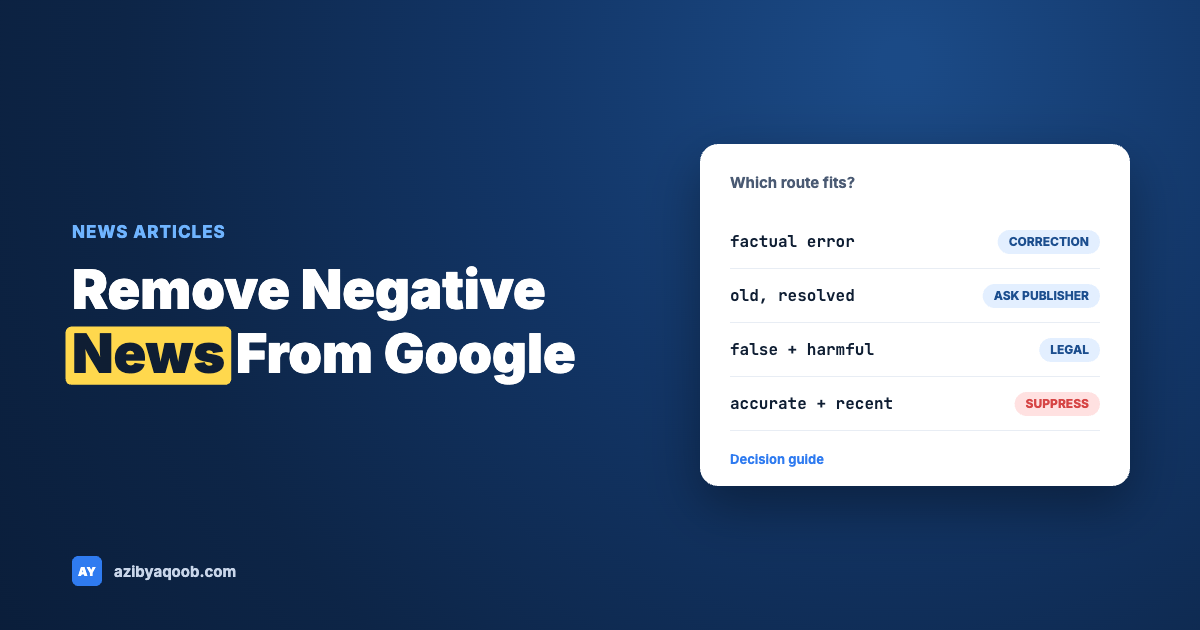
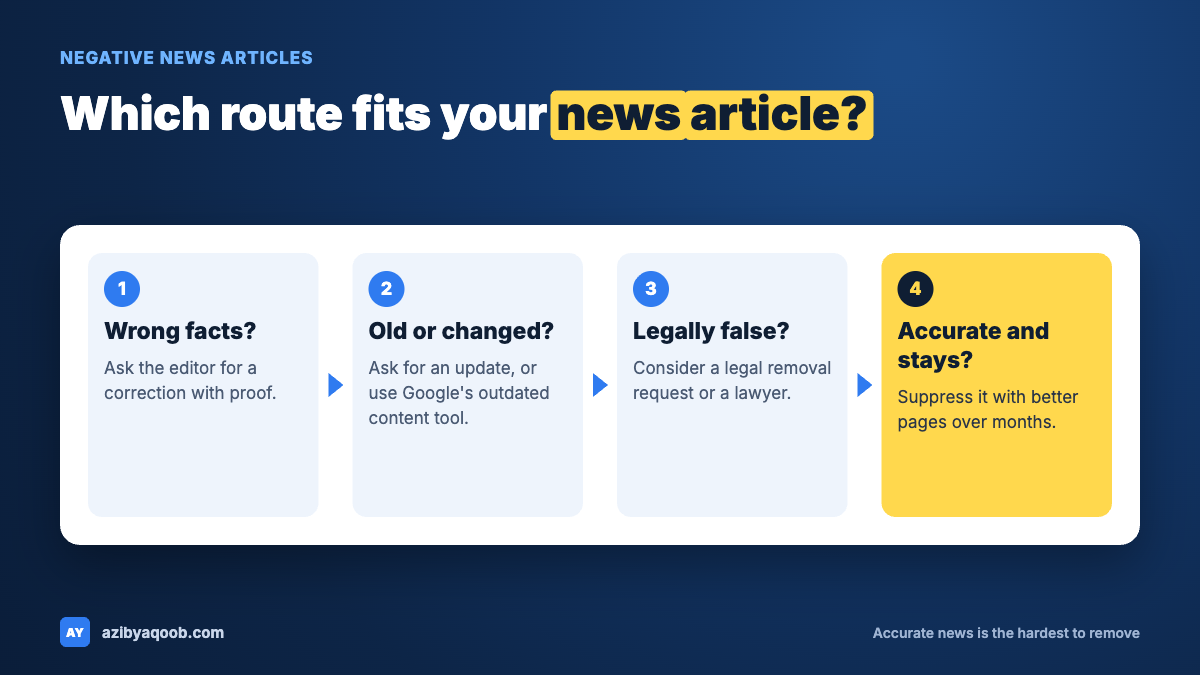
- Wrong facts: send the editor a correction request with proof. A correction is far more likely than deletion.
- Old story, matter resolved: ask the publisher about an update, anonymisation or unpublishing policy. Some outlets have one, many do not.
- False and harmful: a legal route may exist. Speak to a lawyer, and read Google’s defamation page before you file anything.
- Accurate and newsworthy: Google rarely removes it. Plan to suppress it.
Table of Contents
Why news articles are the hardest to remove
Google does not own the page. Its help says it can only act on its own search results, and that the best person to remove a page is the website owner. For news there is a second hurdle: Google weighs the public interest and defers to journalistic judgment. Its personal info page says content that is newsworthy may not be taken down.
That does not mean you are stuck. It means the order of steps matters, and the first step is always the publisher.
Step 1: Work out which case you are in
| Your situation | Best first move | Likelihood |
|---|---|---|
| Wrong name, wrong facts or mixed up with someone else | Correction request to the editor, with proof | Reasonable |
| Charges dropped, case dismissed or record cleared, but story unchanged | Ask for an update or note; ask about the outlet’s policy | Mixed |
| Article is old and has little public value now | Polite request for anonymisation or unpublishing | Low to mixed |
| False and damaging statements | Lawyer, then Google’s defamation form | Needs evidence |
| Accurate, recent and in the public interest | Suppression | Removal unlikely |
The likelihood column is a rule of thumb from how these requests tend to be judged, not a prediction for your case.
Step 2: Contact the publisher
Find the corrections or contact page on the news site. Many outlets list a corrections email or an editor’s address. If there is none, use the general newsroom contact.
Keep the message short, polite and specific. Give the exact URL, say what is inaccurate or outdated, attach proof, and say what you want: a correction, an update, or removal. Do not threaten. Threats often make editors dig in, and they can turn a small story into a bigger one.
Include only what an editor can check quickly:
- The exact URL and headline.
- The specific sentence or fact that is wrong, quoted exactly.
- Proof: an official letter, a court document, a record of the outcome, or a primary source.
- The single outcome you want, so the editor does not have to guess.
- A reply address you actually monitor.
Allow a week or two before you follow up once. If you hear nothing, try a second contact such as the newsroom or the publisher, and keep the tone the same.
Use AI to draft the request, not to argue
A clear email is easier to say yes to. Give an AI tool your facts and ask for a calm draft. Check every statement against your documents before you send it.
Draft a short, polite email to the editor of a news website asking for a correction.
Article URL: [paste URL]
What the article says that is wrong or outdated: [paste the exact sentence]
What is true, with evidence I can attach: [describe the evidence, for example a court order or an official letter]
What I am asking for: [a correction / an update note / removal]
Rules: under 150 words, no threats, no legal claims, no emotional language, one clear request. Do not add any facts I did not give you.
What it does: produces a short request an editor can act on. Paste your own details in the brackets and attach your documents yourself.
Step 3: Check what Google can do
If the publisher says no, Google is the next place to look, but its limits are real.
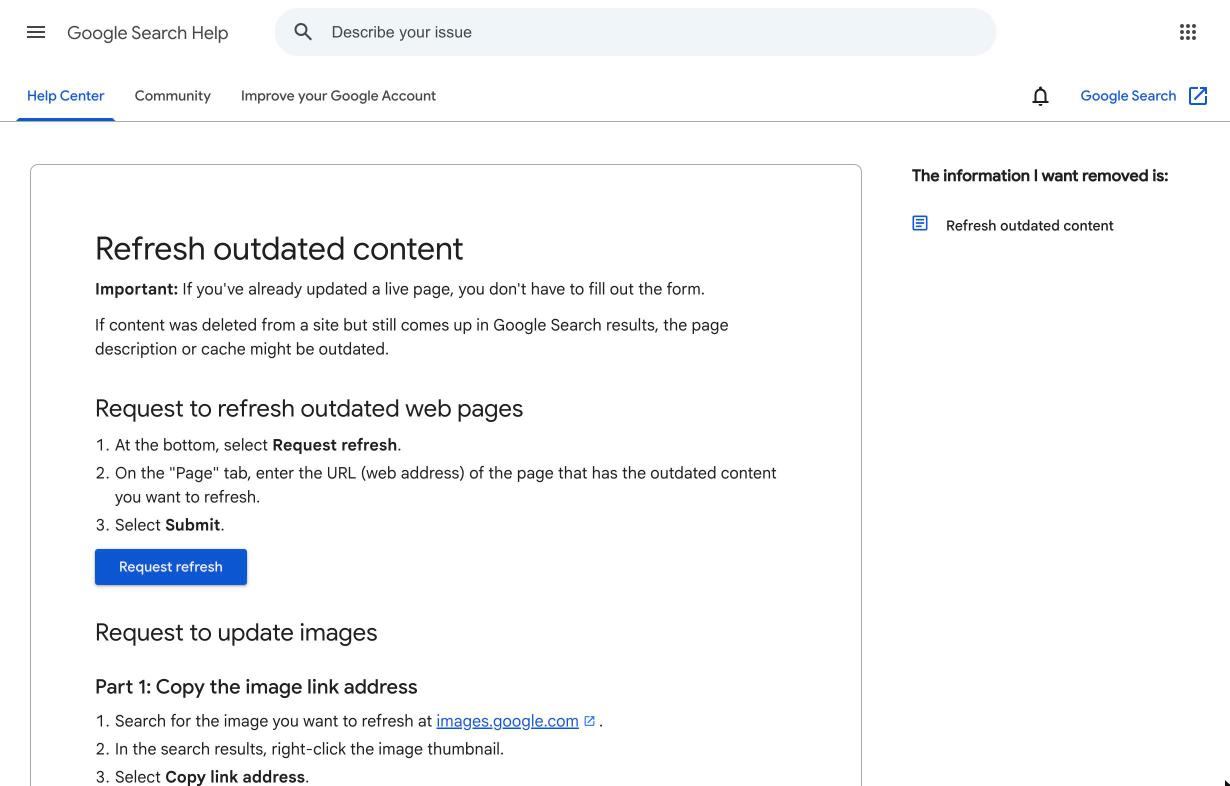
- Already changed or deleted: if the page is gone or edited but Google still shows the old text, use Google’s tool to request a refresh of outdated content. It only works when the source has already changed.
- Personal info: Google’s page on removing personal info covers items such as government ID numbers, bank details and private records. A news story that merely names you is not in that category.
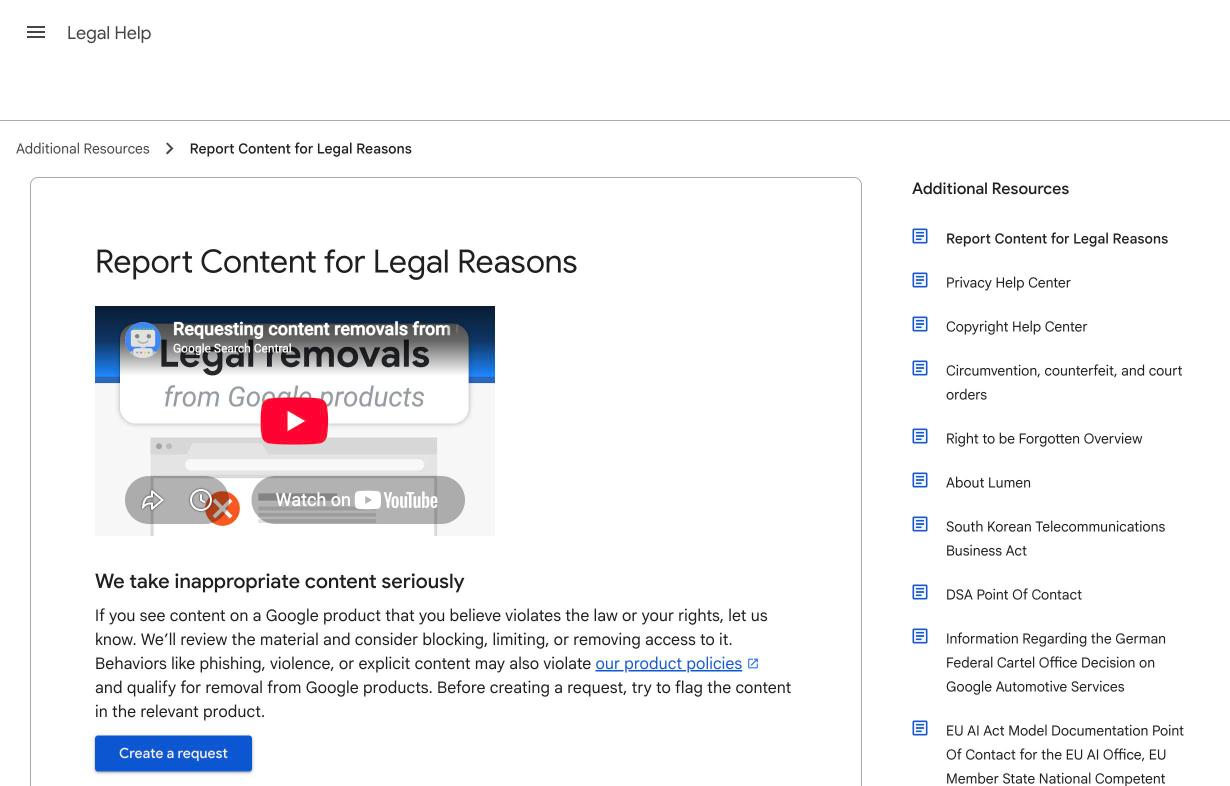
- Legal requests: content that breaks the law can be reported through Google’s legal help, and Google says it may restrict access in the relevant country. The page also suggests contacting the website owner, because content can still exist elsewhere.
If you think the article is defamatory
Google’s Defamation Overview describes defamation as a false statement that harms a person or business. It says Google reviews requests against local law and advises contacting the site’s webmaster first. It weighs the source: it gives strong deference to government pages, and it weighs journalistic judgment for news. It also says it cannot judge truth like a court, so reliable evidence, such as a favourable court ruling, carries weight.
In practice that means opinions you dislike do not count, accurate reporting does not count, and you need evidence. If you have a real claim, talk to a lawyer before you file, since false legal claims can come back on you.
A real example of removal at the source
In 2019 a well-known private school in Pakistan had a negative news article and a forum thread sitting at positions 3 and 4 for the school’s name. Both were removed within about two months, through a mix of direct outreach, legal routes and, mostly, PR. I keep the exact method private. When I checked a year later, both were still gone.
The point is not that one email works. It is that removal at the source can hold, and that it came from several angles at once.
Confidential help
Stuck with a news article you cannot shift?
If you need help with a negative news article, send me the link and what is wrong with it. I will tell you whether a correction, a removal request or suppression is the realistic route.
Get confidential helpYour message stays private. No obligation.
Step 4: If it stays, push it down
When the article is accurate or the publisher refuses, the practical route is to suppress negative search results by ranking better pages above it. In short:
- Audit your page one and note which slots are negative.
- Build or improve owned pages: a site on your name or brand, a complete LinkedIn profile, other profiles that tend to rank.
- Earn coverage on trusted sites: interviews, guest posts, association pages and local press.
- Link everything together and make sure it is indexed.
- Monitor monthly.
A US client had local news articles about a petty crime showing up for their personal name. We worked together for about seven months, and by the end all of the negative articles sat on page 3. After two months of watching them stay there, I suggested the client stop. I kept an eye on the results for a year after that and they never resurfaced.
That is a typical suppression arc: months of work, a clear end point, then monitoring instead of spending. Another client case went differently: one negative result moved off page one, another appeared weeks later, then a Google algorithm update cleared the negative results. Results can move in either direction, so set expectations early.
Step 5: Keep watching
- Set a Google Alert on your name and brand so you hear about new articles.
- Re-check your results monthly in an incognito window.
- If the story gets republished, treat the new URL as a new negative result and work out how to outrank it.
For a deeper look at how long this kind of work can take, see the guide on how long SEO takes to work. If you want an overview of the route options beyond news, how to repair your online reputation is a good companion.
What to avoid
- Posting angry replies or legal threats online. It can draw more attention to the article.
- Paying a site that offers to remove the story for a fee without checking it. Google lists content on sites with exploitative removal practices as something it may act on.
- Filing a defamation request for a story that is simply accurate. It will be rejected.
- Asking an AI tool to write legal claims for you. Use it for tone and structure only.
FAQ
Can I remove a negative news article from Google?
Sometimes. Articles with factual errors or outdated information have a chance if the publisher agrees or a valid request is filed. Accurate, newsworthy stories are rarely removed.
Will Google delete a news article if I ask?
Google removes things from its own results, not from the website. It weighs public interest and journalistic judgment, so a request for a true story usually fails. Contacting the publisher first is more productive.
How do I ask an editor to correct or remove an article?
Send a short, polite email with the exact URL, what is wrong, proof, and the single outcome you want. Avoid threats and emotional language.
What if the article is accurate but old?
Ask whether the outlet has an update or anonymisation policy. If it does not, suppression is the usual route.
How long does it take to push a news article down?
Often several months. A case I worked on took about seven months to move all of the negative articles to page 3, but your timeline depends on how strong the article and your name are. Nobody can promise a result.
Confidential help
Need help with a negative news article?
If you need help with a news story that ranks for your name, I will give you a straight answer on what can be removed and what needs suppression, based on your case.
Send me the articleYour message stays private. No obligation.